

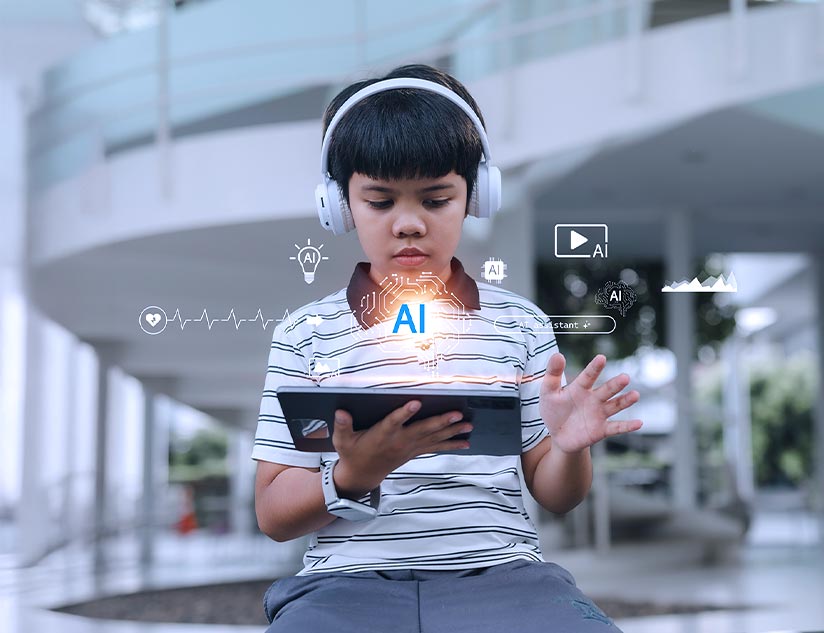
Nearly 378 million people were using AI in 2025. This was a massive 490% increase from the 64 million recorded in 2024. AI has rapidly gone from a futuristic idea to an everyday reality. The sheer scale and speed of AI penetration in our daily lives is dizzying. AI in education has an even deeper impact—it changes how students learn and think. For teachers, a sea of opportunities opens up, but not without waves of uncertainty. The pressure to adapt quickly can feel like unchartered waters. The expectations of leveraging AI and protecting students from its adverse effects may seem herculean. And this has become a central challenge for digital learning platforms, educators, and publishers alike.
Getting to the Roots of AI Anxiety
Students and teachers have questions. Will AI in education replace teachers or human creativity? Does it make cheating too easy? Is student data safe? Will students be falsely accused of using AI?
Higher education learners are insecure about a technology undermining their hard-earned skills. The fear that entry-level jobs might disappear is taking over the joy of stepping into a world of tremendous possibilities. At the end of the day, workplaces are integrating AI at the core and today’s youth may not be fully prepared for that shift. Their credential-based learning seems outdated as AI spreads its roots in education. Thus, the skepticism.
Teachers have multi-faceted concerns. Firstly, with AI leading instruction, academic integrity is at stake. To avoid that, educators must learn to use the technology effectively. And they must do it fast to keep pace with the technology’s adoption rate. This can lead to AI-resistance.
Administrators also worry that integrating AI will add to their workload and take too long to deliver real productivity gains.
For those new to the technology, AI is a black box. They don’t know how it works or trains, or how they can use AI in education to make their respective experiences better. Their worries are real, AI is indeed a double-edged sword with the future of students hanging in the balance. To move forward, users’ concerns must be urgently addressed.
Creating a Safe Space with a Digital Learning Platform
The global market for AI in education is estimated to expand at a CAGR of 31.2% from 2025 to reach a value of 32.27 billion by 2030. K-12 publishing plays a vital role in positioning AI as an ally. The first step to doing so is overcoming institutional inertia. Nearly 76% of teachers feel unprepared for AI. In K-12 education, fear ripples from administration to educators and from educators to students and their parents.
The goal is to replace fear with fluency: understanding when to use an AI-powered tool and when to do the work ourselves. From training institutions to hiring schools, preparing teachers for AI-driven classrooms is essential. Teacher prep programs and course creation need refinement and streamlining.
Plus, educators need a safe space where AI-readiness meets application. Digital learning platforms and course authoring tools must include handholding modules that educate teachers to effectively employ AI for their tasks. Only AI-sensitized teachers can build AI-readiness among students.
Read the blog: AI-Readiness in K12 Education: How MagicBox Enables Smart, Flexible Innovation
As K-12 publishing evolves course development workflows with AI, collaborative efforts of schools and districts are needed to transform education. In an AI-powered educational ecosystem, publishers need to understand what teachers need. This calls for solutions designed with a human-in-the-loop approach. This also paves the way for a reliable AI-powered course and assessment authoring platform. One that accelerates teachers’ work, takes over mundane tasks in K-12 publishing workflows, and drives improvement in the quality of education.
For students, a safe space is integrating the technology within digital learning platforms. An AI learning assistant for personalized support can be a gamechanger in sustaining engagement and motivation. When students use AI within a managed platform, they can truly engage in a curated educational experience. This can build AI-confidence.
Additionally, compliance must be prioritized. Digital learning platforms must adhere to privacy laws, such as FERPA and COPPA. This is to make privacy an intrinsic part of the learning ecosystem.
From Anxiety to AI Fluency
Digital learning platforms that bring AI into the limelight can remove the fear of the unknown. They can prepare students to ask better questions. For instance, rather than asking AI to write an essay, educators can instead encourage students to use it to identify gaps in their logic. Similarly, for teachers, AI can serve as a powerful support—helping them refine lesson plans, adapt content to different audiences, and, at the same time, ensure alignment with curricular goals. This turns a potential threat into a powerful thought partner.
The path forward for AI in education is human-centered technology adoption. There is no choice between humans and AI. It is about optimal utilization of AI to improve human effectiveness. By focusing on ethical AI and digital equity, the technology can be turned into a tide that propels K-12 publishing, teaching, and learning ahead.