

For the most part, digital education has been largely driven by the need for accessibility. The premise was that if we put a tablet in every student’s hand and a PDF on every screen, learning would follow. But the education sector is facing a sobering reality today. Reading enjoyment among children and teens has plummeted to its lowest level since 2005, with only 34.6% of 8-to-18-year-olds saying they enjoy reading in their free time.
The problem is that static PDFs and basic eBook Readers are no longer enough. When digital content acts merely as a flat replica of paper, a usage gap emerges, where districts buy the content, but students don’t engage with it. For K-12 publishing, this creates a significant risk that adoption doesn’t mean actual usage, which then leads to poor outcomes and failed renewals.
Engagement is no longer about content availability—it’s about intelligent interaction. To survive, digital content must stop being a destination and start being a dialogue.
From Passive Reading to Active Learning
Traditional eBook Readers were designed merely as delivery tools. However, the next generation of digital learning platforms is shifting toward “experience platforms.” The goal is to move the student from a state of “read and move on” to “read, reflect, respond, and reinforce.”
By integrating an AI learning assistant directly into the reading interface, the environment becomes responsive. Studies show that this shift is effective, with students in AI-enhanced active learning programs achieving 54% higher test scores than those in traditional environments. The MagicBox eBook Reader exemplifies this evolution, turning every page into a launchpad for deeper inquiry through clickable hotspots and real-time support.
In short, to encourage usage, eBook readers must evolve from content repositories to responsive learning environments.
What an Embedded AI Learning Assistant Actually Does
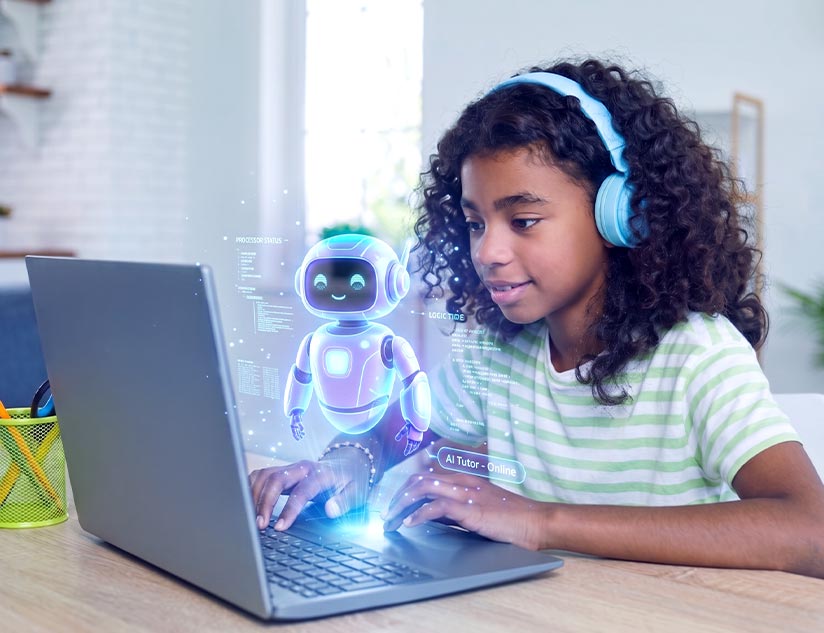
On a high-performing AI-powered eBook platform, AI acts as a 24/7 personalized tutor. For example, MagicBox’s AI Learning Assistant (KEA) provides tools that humanize the digital experience:
Simplify Complexity
Rather than struggling with a dense paragraph on photosynthesis, students can ask the AI assistant to summarize the concept in simpler terms instantly.
Real-Time Practice
The learning assistant can generate flashcards and practice questions directly from the text, helping students self-assess before moving forward.
Contextualized Responses
Students can ask questions like, “Define this term in the context of the story,” and receive answers with transparent source attribution.
Multilingual Support
Language gaps can be bridged for English Language Learners (ELL) by providing translations and simplified explanations.
Personalized Feedback
An AI/ML-powered grading assistant can score short- and long-form answers and provide instant, individualized feedback.
All this transforms your content into a personalized tutor. This way you aren’t just selling a book; you’re selling a measurable learning outcome.
Why This Matters for K-12 District Adoption
When evaluating edtech AI solutions for districts, they aren’t looking for bells and whistles. What they want are solutions for systemic crises. The demand for safe yet effective tools is highlighted by the fact that 86% of educational institutions already use generative AI.
District priorities today include:
1. Personalized Learning in K-12: AI allows teachers to provide one-on-one attention to students.
2. Learning Outcomes: 82.4% of students in a 2025 survey stated that using AI helps improve their academic performance.
3. Reduced Workload: AI tools save teachers an average of 5.9 hours per week, allowing them to focus on mentoring rather than administration.
By ensuring engagement, K-12 publishing can drive usage, while usage in turn will generate data, which will promote renewals.
The Competitive Advantage for Publishers
For publishers, embedding AI within eBook Readers is a massive differentiator in RFPs. It moves your digital catalog from a “commodity” to a “service.” By allowing publishers to train the AI on their specific, high-quality content, edtech solutions for districts ensure that the AI is accurate and curriculum-aligned, unlike generic web-based chatbots.
Publishers can now provide districts with granular data on where students are struggling, allowing for data-driven instruction that proves the value of the content.
Designing for Trust, Compliance & Accessibility
To succeed in K-12, AI must be responsible by design. As of late 2025, 31 US states had published guidelines on AI use in schools. To drive adoptions, publishers must ensure their assistants are fully compliant with such guidelines, and COPPA and FERPA standards. They must also ensure transparency by clearly identifying AI-generated content and citing sources from the textbook. Plus, K-12 publishing must enable accessibility through text-to-speech, closed captioning, etc.
The eBook Reader is Becoming the Classroom
The future of K-12 digital content isn’t just interactive—it’s intelligent. As the boundaries between content and instruction blur, eBook Readers are no longer just a place to read. They must evolve into a space where learning happens in real-time. For publishers, the question is no longer “Should we add AI?” but rather, “How deeply is AI embedded into the learning moment?” Ready to lead the next wave of K-12 digital transformation? Speak to the Magic team.