
When a textbook login is shared in a WhatsApp group or a downloadable PDF is passed around a class, the effect is more than a single lost license. They reach platforms where they can be accessed for free by millions of users. MUSO recorded 65.8 billion visits globally on publishing-piracy websites in 2025. That accounted for almost a third of piracy visits across all sectors. Piracy means revenue loss for K-12 publishers in an already competitive space. The need of the hour for edtech publishers, therefore, is robust eBook piracy protection across licensing tiers.
Why K-12 Publishers Are an Easy Target
K-12 education involves diverse participants and a complex licensing architecture. Shared classroom logins, downloadable PDFs, and screen grabs allow content to move outside the learning ecosystem. In K-12 learning platforms, content often outlives a school year. Uncapped classroom eBook licensing creates vulnerabilities. Malicious users gain access and may unlawfully copy or redistribute a K-12 publisher’s intellectual property (IP). This impacts revenue and undermines the publisher’s authority to deliver impactful educational content.
How eBook Piracy Protection Actually Works
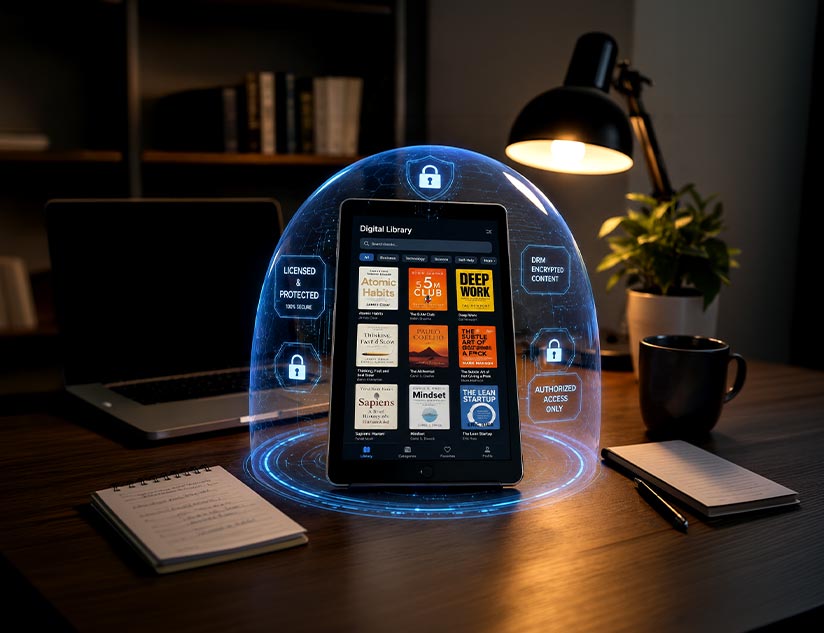
eBook piracy protection imposes security protocols and access restrictions throughout content publishing and distribution. A digital rights management (DRM) system designed specifically for edtech integrates with the LMS. It controls how users access the digital content and for how long. Some controls a DRM for K-12 publishers must have:
Mechanism to Block Copying, Printing, and Screen Grabs
DRM restricts users from copying to a clipboard, printing, and screen capturing. This prevents manual content distribution outside the learning ecosystem. The key to eBook piracy protection is to optimize these controls across devices and operating systems, along with detecting and blocking third-party tools that aid content theft.
Device Limits
Digital rights management uses a batched classroom eBook licensing model for eBook piracy protection. It limits the maximum number of registered devices that can log in per account. As only one learner can log in at a time with one account, users avoid sharing credentials with unauthorized people.
Time-Bound Access and Expiry Dates
In time-bound access, the DRM automatically revokes usage rights when course duration expires or subscription ends. For the K-12 segment, effective eBook piracy protection also means that a student cannot access the resources beyond their school year without explicit access extension.
Role-Based Access Codes
DRM enables administrators to configure separate access codes for every role. They grant the necessary set of limited-time permissions to each role. For instance, students can access learning resources and digital labs, while educators can also access answer keys, lesson plans, teaching guides, and question banks.
Integrated Learning Analytics
Integrating usage analytics within the DRM system helps monitor concurrent logins and downloads. It allows the system to spot anomalous user behavior and flag credential theft or illicit sharing in real time.
MagicBox’s DRM system is tailored to ePub3 textbooks and learning materials. It works across standardized learning resources in all formats, including text, audio, and visual. It also supports role-based bulk licensing and individual access. This allows K-12 publishers to offer flexible, role-based access. It can automatically revoke access rights after course completion or license-code expiry, and limit the number of devices. Plus, it provides short-term trial codes for pilot testing with a few schools. MagicBox’s DRM comes integrated with learning analytics to enhance eBook piracy protection. It flags suspicious account activity, ensuring that only authorized users access learning resources at any point in time across the digital learning platform.
| Risk | Protection | Classroom Example |
|---|---|---|
| Unauthorized Distribution | Copy, print, and screen-grab blocks | Even authorized users cannot copy content or print pages. Screen grabs are blocked. |
| Account Sharing | Device registration limits | One account-one device policy for every student. |
| Overstayed Access | Time-bound auto-expiry | Access automatically ends when the course concludes. |
| Exposed Teacher Assets | Role-based access codes | Students see textbook content while teachers unlock answer keys. |
| Credential Theft | Integrated learning and usage analytics | Flags simultaneous logins, attempts to download or bypass security. |
What DRM Can’t Do
DRM can deter unauthorized access to some extent but it can’t guarantee 100% prevention. The key to protecting revenue and IP is to make misuse inconvenient, hard, and time-consuming. MagicBox believes that DRM for K-12 publishers must be based on a sustainable strategy to ensure ease of use while preventing misuse. DRM that makes access difficult even for legitimate users hampers engagement. This means K-12 publishers must carefully choose how they protect digital textbooks.
Also Read: 5 Layers of eBook Piracy Protection
How to Choose a DRM Solution: 6 Questions to Ask
K-12 publishers work within a regulated ecosystem, governed by stringent privacy, security, and accessibility laws. Here are some questions that can help you pick a compliant DRM to prevent eBook sharing without affecting ease-of-use for licensed users:
- Does it work with ePub3, SCORM, LTI, and xAPI?
- Can I set access by class, teacher, and student?
- Can I control expiry and device counts per license?
- Does it support B2B bulk and short-term sales?
- What analytics do I get?
- How easily does it plug into the LMS and eReader schools already use?
How MagicBox’s DRM Protects Digital Textbooks
A K-12 publisher’s learning resources are their IP. Protecting it requires a classroom eBook licensing mechanism that protects digital textbooks and other resources without hurting user experience. MagicBox’s DRM system for K-12 publishers is designed especially for eBook piracy protection in online learning environments. Schedule a demo with MagicBox to learn how the DRM solution for K-12 publishers protects both IP and revenue.