
eBook piracy is a huge revenue leak for publishers, especially following advances in AI that have given malicious actors tools for content theft. The latest numbers are eye-opening, with a February 2026 report by the Association of Italian Publishers and the Federation of Italian Newspaper Publishers revealing that piracy accounts for nearly 30% of Italy’s book market, wiping out a staggering €2 billion in revenue. But this isn’t just an isolated issue. To put the sheer scale of the problem into perspective, piracy websites racked up 1.2 trillion visits worldwide between January 2020 and December 2025.
For K12 publishers, the risk is dangerously amplified, since a single leaked access code or shared credential file can expose an entire district’s worth of licensed digital assets. Relying on a single lock on the door isn’t enough anymore. True eBook piracy protection requires an ecosystem in which multiple safeguards stack together. If you want to know how to protect eBooks from piracy in a crowded, high-stakes market, you need a strategy built on five non-negotiable layers of defense.
Layer 1: Content Control — Stop Unauthorized Copying, Printing & Screen Grabs
The most basic form of digital theft happens through simple everyday keyboard shortcuts. If your digital textbooks are delivered as static, unsecured PDFs, they are a huge risk. Anyone can hit Ctrl+C, run a screen capture tool, or print entire chapters out to distribute offline.
Robust content control within the premium eBook DRM software environment locks down these vulnerabilities. It proactively stops screen recordings, blocks copy-paste commands, and restricts printing permissions to authorized limits. Implementing strong eBook DRM protection ensures that your content can only be read as intended, not scraped or replicated. This turns your digital curriculum from an exposed file into a secure environment where your hard work remains safe from casual duplication.
Also Read: Advanced DRM systems for textbook
Layer 2: Share Control — Prevent Illegal Distribution Before It Happens
When resource-strapped schools or well-meaning educators try to manage tight budgets, unauthorized “sharing” occurs frequently. A single user downloading an offline copy and forwarding it to a handful of colleagues can quickly spiral into hundreds of missing licenses.
To effectively protect against eBook piracy, publishers must use dynamic share controls. Modern DRM solutions for digital publishing apply personalized watermarks to digital assets. If an account attempts to stream or share a file illegally, the platform traces the leak back to the exact source. Powerful eBook access control software allows you to track distribution and links content to validated accounts, so that you can prevent files from spreading across unverified users.
Layer 3: Expiry Control — Time-Bound Access That Enforces License Terms
K12 adoptions work on strict seasonal timelines. When a school district purchases an annual software seat or a digital curriculum bundle, that access needs a hard stop date. Leaving digital keys active indefinitely is one of the fastest ways to cause a major revenue leak.
This is where time-bound expiry control comes in. A high-quality DRM software for eBooks guarantees that licenses automatically expire exactly when the contract ends. Whether you are providing a temporary 30-day trial access window to win a new district or enforcing a strict 12-month instructional period, automated expiry ensures you optimally monetize your intellectual property.
Layer 4: Device Control — Limit How Many Screens Can Access Your Content
Without a hard ceiling on logins, a single username and password could theoretically serve an entire computer lab or classroom. Device control prevents this.
Enterprise-grade eBook piracy protection allows publishers to set specific per-device access caps. For example, you can allow a student to log in on two devices (like a school Chromebook and a home tablet) while limiting teachers to three screens. Managing device limits allows smooth classroom experiences without your content falling prey to password-sharing.
Layer 5: Access Code Management — Separate, Secure Entry for Teachers & Students
Teachers and students use digital platforms in totally different ways. While teachers need answer keys, lesson plans and data reports, students just need their lessons and assignments. Role-based DRM for educational publishers handles these differing needs seamlessly by giving everyone a unique login tier, keeping sensitive teacher resources safely out of student sight and also offering optimal eBook piracy protection.
Also Read: Best DRM for Education Content Providers
How These 5 Layers Work Together
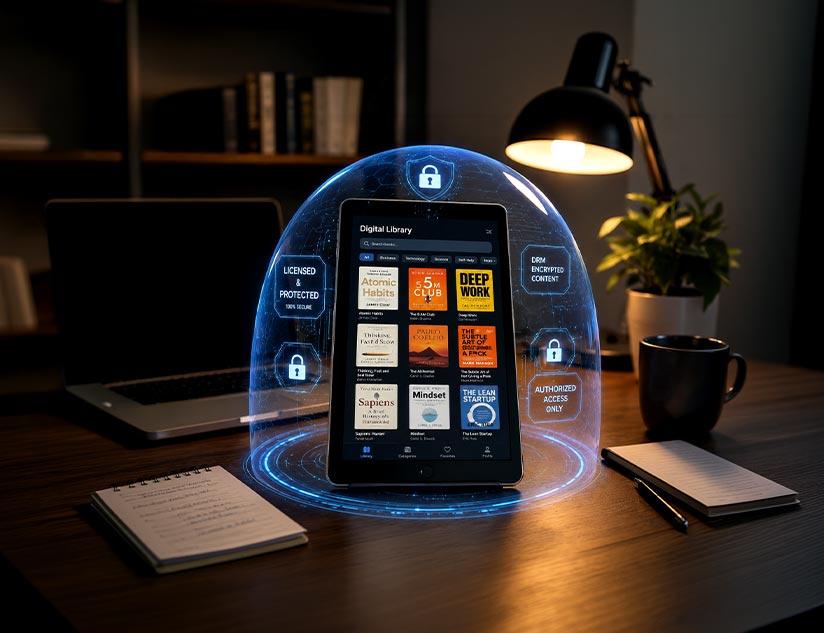
No single digital lock is entirely foolproof on its own. Real eBook piracy protection comes from stacking all five controls together like a digital vault. For instance, MagicBox’s DRM for educational publishers blocks unauthorized copy-pasting, printing, and screen grabbing, while automatically cutting off access the moment a subscription period ends. To keep access fair and secure across a district, you can also cap the number of devices allowed per account, or issue separate, role-based access codes.
Gives your digital content a smart protective shield that addresses security from every angle. Schedule a demo today.