

The US Department of Justice published the ADA Title II digital accessibility compliance rules and brought them into effect on April 20, 2026. One of the key requirements is that districts are accountable for the accessibility of third-party content they license, including K-12 digital content procured from educational publishers. This means that all digital learning resources adopted hereon in will be tested against these compliance mandates. Publishers whose content, platform, instructional approaches, and assessments do not meet the standards will be filtered out from the RFPs first. Compliance with these accessibility requirements can turn into a competitive advantage for K-12 publishers.
What the ADA Title II Rule Actually Requires
WCAG 2.1 AA mandates that K-12 digital content, mobile apps, and software be Perceivable, Operable, Understandable, and Robust (POUR) for users with disabilities. This means that all learning resources should be available in visual and audio formats. All teaching-learning interfaces must be easy to navigate for all kinds of users. All the information delivered must be imparted in a manner that is understandable for students at the specific learning level. And that platforms are compatible with modern learning tools and work seamlessly across devices, browsers, and screen sizes.
The latest update necessitates that large school districts meet compliance requirements by April 26, 2027, and smaller districts by April 26, 2028.
Why This is a Publisher Problem, Not Just a District Problem
Digital accessibility is a publisher problem because for decision-makers, it only changes who they pick and why. For publishers, it changes how they deliver K-12 digital content.
Moreover, districts are increasingly shifting toward evidence-based adoption. This means only the publishers who provide tangible proof of accessibility compliance will be eligible for licensing.
Districts may outright reject publishers with proposals where promises are made without actual evidence. These circumstances make content and the platform the liability of districts.
What Districts Will Start Asking Publishers For
Districts are no longer accepting vague promises of future compliance. They demand proof before signing on the dotted line.
WCAG Conformance Documentation (VPATs)
It is likely that school districts explicitly mandate a Voluntary Product Accessibility Template (VPAT), specifically used to generate an Accessibility Conformance Report (ACR). Even if they don’t, K-12 publishing leaders can use it to stand out from the crowd. VPAT provides a detailed, criteria-by-criteria breakdown of how your learning materials align with WCAG standards. This includes all digital accessibility rules, such as K-12 digital content, LMS, and third-party tools, such as Canvas, Google Classroom, Moodle, Schoology, and Clever.
Note that only surface-level checklists will not pass. Decision makers now demand data validating that your core workflows actually do what they claim. Integrating learning analytics into the same system can also offer insights into how your platform actually improves the academic performance of students with special needs. This can be the differentiator that gets K-12 publishers a place in the next round.
Also Read: Title II Accessibility Compliance for Publishers
Built-In Accessible Alternatives
Beyond the documentation, districts and users expect accessibility features to be embedded by design directly into the user experience. This starts with aligning K-12 publishing processes to accessibility requirements. The top accessible content requirements for publishers are:
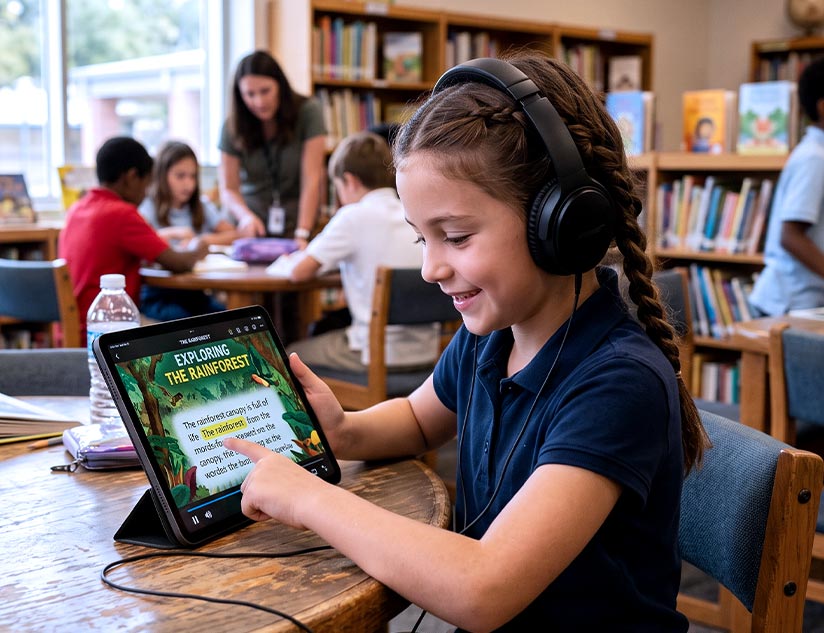
- Text-to-Speech (TTS): Native audio tools or seamless integration with standard screen readers so text content is accessible to visually impaired or neurodivergent students. MagicBox’s eReader offers this by default, along with offline access for students with connectivity issues.
- Navigable Structure: Logical, robust keyboard, touch, and pointer navigation that allows students to access menus, buttons, and interactive elements via intuitive heading hierarchies.
- Alternative Text (Alt Text): Meaningful text descriptions embedded with a variety of visuals, including images, charts, and instructional graphics.
How to Stay Ahead of the Curve
To get started, you must audit your existing digital learning environment and resource catalogue against ADA Title II K-12 compliance guidelines. This serves as your baseline, highlighting exactly what you need to work on to align your K-12 digital content with accessibility standards.
More importantly, retrofitting an interactive digital textbook or learning management system (LMS) after it is built is both time- and resource-intensive. Your curriculum development team should have access to an advanced content development toolkit to bake universal design principles directly into their workflows. MagicBox’s AI-powered course authoring and distribution platform does exactly that. The award-winning solution enables educators to combine accessibility with personalization to offer exceptional user experiences with compliant K-12 digital learning content.
The Bottom Line
Digital accessibility is no longer a future risk or a checkbox, it is a procurement gatepass. Educational publishers who cannot produce verifiable VPATs or demonstrate native accessibility features in their K-12 digital content risk being disqualified from adoption processes even before the competitive evaluation begins. Partnering with an inherently compliant technology infrastructure provider ensures that your content is ready for strict K–12 review cycles before the deadline. Learn how MagicBox’s WCAG 2.1 compliant platform helps publishers meet district requirements. Schedule a demo today.