Digital Library Platforms for K-12 and Educational Publishers

Turn your catalog into a branded K-12 digital library.

Publish interactive eBooks, distribute them securely to schools and districts, and give every student one reading experience, online and offline, on any device.

Schedule a Demo

What is a digital library platform for K-12 publishers?

A digital library platform gives a publisher one place to create, protect, distribute and deliver content to schools and districts. For publishers, that means quicker dissemination of content, real-time visibility into how it is received, and engagement with readers after the sale. For schools, it means eBooks for school libraries that are easy to find, easy to open and easy to read, on whatever device a learner has.
MagicBox brings the pieces together as a single digital publishing platform: authoring, ePub3 conversion, licensing, DRM, a white-label eReader and analytics. It is built for educational and K12 publishers who want to reach schools, districts and libraries with interactive content, not static files. Whether you are moving print-first titles online or growing an existing catalog, one digital learning platform keeps your content, your customers and your data in the same place.
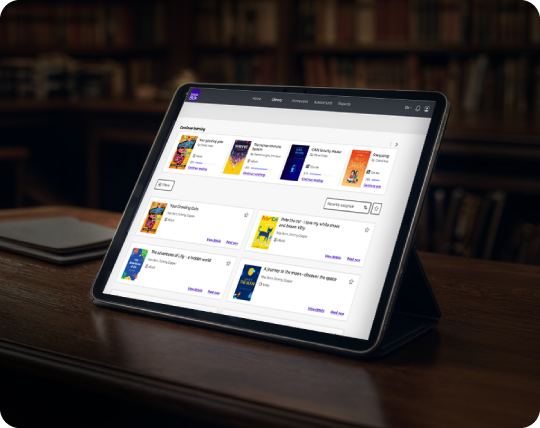
Digital Library Platform for K-12 Schools and Publishers

One K-12 digital library platform for everything you publish

From book formatting and authoring to distribution and reader analytics, the tools you need to run a K12 digital library platform sit in one system.

Book Formatting

Book Formatting & Authoring Tools

Enrich ePub3 eBooks with text, audio and video clips, documents and assessments. Convert existing print content into fixed-layout ePub3 in one click, and use built-in templates and themes to brand every title.

ebook publishing

eBook publishing software

Publish video, audio, PDF, ePub, SCORM, games and simulations in one library. Interactive media lifts reader engagement far beyond what a static PDF can offer.

Library and content distribution

Library and content distribution

Bundle titles and resources into the digital library for easy access. Sell business-to-business, business-to-customer and into the library market, with review copies and trial access through access codes.

Licensing and DRM

Licensing and DRM

Offer user-based, domain-based or device-based licenses. Content, share, expiry and device controls help prevent piracy so only authorized users can access and download your titles.

K12 library digital reading platform

K12 library digital reading platform

A white-label eReader with online and offline access, bookmarks, highlights, notes that sync when learners reconnect, read-aloud support and clickable hotspots for audio, video, links and assessments

Accessibility built in

Accessibility built in

Screen reader compatibility, text-to-speech, alt text and semantic tagging, font resizing, high-contrast display and keyboard navigation, in a reader built to WCAG 2.1 and EPUB Accessibility 1.1.

LMS and rostering integrations

LMS and rostering integrations

LTI-compatible LMS integration, plus Moodle, D2L and Blackboard. With MagicSync, connect standards and apps such as OneRoster, Google Classroom, Clever and ClassLink.

Analytics and reporting

Analytics and reporting

See what content is selling and what is not, track reader trends, and engage readers through feedback and issue resolution. Assessment analytics show student strengths and weak areas.

Digital library platforms for K12

A Branded Digital Library for K-12 Schools

Schools and districts want content that is simple to access and works with the systems they already run. MagicBox lets you deliver a Digital Library for K–12 School Districts under your own brand, with the licensing, sign-in and integrations districts expect.

Digital library platforms for K12 students

Give each school, district or association a branded site where students and members access materials with license and access codes.

Use the access code generation tool to grant temporary access to a title or a collection for a timeframe you set, then see how users engage.

Stay aligned with FERPA, COPPA and GDPR, and with industry standards such as LTI, QTI and SCORM.

Offline access keeps learning going in low-connectivity environments, which supports digital equity for K-12 learners.